COMMON BEARING
Where are you trying to go?
Common Bearing helps you find the resources, people, and opportunities that match where you are in your aviation journey.
I'm starting from zero
Understand the pilot path before you spend your first dollar or log your first hour. Explore training costs, medical certification, flight-school selection, financing, career paths, and the road to 1,500 hours.
I need a flight instructor
Find independent CFIs based on location, aircraft access, ratings, training goals, and the type of instruction you need.
I'm a CFI and want to be found
Create a free instructor listing so pilots can find you based on location, ratings, aircraft, experience, availability, services, and training needs.
Need to Build Flight Time?
Find pilots, aircraft access, and time-building opportunities that can help you get the hours you need.
Have Access to an Aircraft?
Connect with pilots looking to build time and explore ways to make available flight time more useful.
I'm looking for Alpha Trainer Resources
Find Pipistrel Alpha trainer aircraft access, instruction, familiarization, operator support, time-building opportunities, and practical aircraft-specific resources.
I need flight time or aircraft access
Find aircraft, time-building partners, block-time opportunities, specific aircraft experience, and other ways to build meaningful flight time.
I have something to offer
List aircraft access, instruction, contract work, ferry flying, time-building availability, partnerships, or another aviation opportunity.
Not sure where you fit?
Tell us where you are today and what you're trying to accomplish. We'll help point you toward the most relevant Common Bearing resource or connection.
Building flight time shouldn't require searching everywhere.
Pilots need hours. Aircraft owners and operators have available time. Common Bearing helps them find each other.
One destination. Three simple steps.
Tell us what you need
Aircraft type, location, hours, budget, schedule and other requirements.
We look for your bearing
We compare your requirements with pilots, aircraft and opportunities in the network.
Make the connection
When there's a potential match, we help connect the right people.
Which side are you on?
I NEED FLIGHT TIME
For pilots looking for:
Single-engine time
Multi-engine time
Time-building partners
Block-time opportunities
Specific aircraft experience
Long-term aircraft access
I HAVE FLIGHT TIME
For:
Aircraft owners
Flight schools
Flying clubs
Time-building operators
Pilots looking for partners
Anyone with available aircraft
Looking for multi-engine time?
Multi time is expensive. Finding the right aircraft—and the right person to split it with—can make a major difference.
Tell Common Bearing what aircraft, location, hours and schedule you're looking for.
Not sure which path fits you?
Tell us where you are and what you're trying to accomplish.
Find Your Bearing
Not sure which Common Bearing path fits what you're trying to do? Tell us where you are today and where you're trying to go. We'll use that information to point you toward the most relevant resource, person, opportunity, or next step.
Prefer to explore on your own?
Find an Opportunity
Tell us where you're trying to go. Common Bearing helps connect pilots, aircraft owners, operators, instructors, and other aviation participants with opportunities that may help them get there
List an Opportunity
Whether you have aircraft access, time-building availability, instruction, ferry flying, contract work, or another aviation opportunity, tell us what you have available.
Find a Flight Instructor
Connect with independent flight instructors based on what you're trying to accomplish, where you want to fly, and the type of instruction you need.
Andy Garcia
Certified Flight Instructor | Commercial ASEL/AMEL • Houston, TX
Experience
1,500+ hours total time with substantial Pipistrel Alpha Trainer experience along with multi-engine in the Diamond DA42/DA42NG, King Air C90 and additional time in a variety of single-engine aircraft.
Instruction Available
• Private Pilot training
• Commercial Pilot training
• Flight Reviews
• Proficiency & Currency
• Checkride Preparation
• Aircraft familiarization and transition support
• High-performance/complex aircraft support where appropriate
Approach
Practical, proficiency-focused instruction built around understanding the aircraft, developing sound judgement, and becoming a more capable pilot, not simply accumulating hours.
Aircraft Experience
Diamond DA42/DA42NG • Piper Seminole/Seneca • Cessna 172 • Piper PA-28 • Pipistrel Alpha Trainer, and other general-aviation aircraft
About Andy
Andy is a commercial single- and multi-engine pilot and Certified Flight Instructor with more than 1,500 hours of flight experience. He has substantial experience in the Pipistrel Alpha Trainer, along with experience in the Diamond DA42/DA42NG, King Air C90 and a variety of other general-aviation aircraft. His focus is practical instruction, sound aeronautical decision-making, and helping pilots become safer, more capable, and more confident in the aircraft they fly.

Don't see the right instructor? Tell us what you're looking for.
Looking for a Pipistrel Alpha Trainer?
Find aircraft access, instruction, familiarization, time building opportunities, and people with real Alpha Trainer experience.

Already have an Alpha Trainer or an opportunity to offer? You belong here too.
Common Bearing connects pilots, instructors, aircraft owners, flight schools, and operators around the Pipistrel Alpha Trainer. Whether you're looking for aircraft access, instruction, experience, operator support, or an Alpha Trainer related opportunity, start here.
Who is this for?
This page is for pilots seeking Alpha Trainer access or experience; students and certificated pilots looking for instruction or familiarization; CFIs transitioning into the aircraft; owners and operators bringing an Alpha Trainer into service; flight schools looking for aircraft specific support; and anyone offering an Alpha Trainer opportunity that others should know about.
What can Common Bearing help you find?
Alpha Trainer aircraft access
Flight instruction and aircraft familiarization
Time-building opportunities
CFI and operator familiarization
Owner and flight-school support
Ferry and repositioning resources
Aircraft acquisition, leasing, or partnership connections
People with meaningful Alpha Trainer experience
Other Alpha Trainer opportunities
Why Alpha Trainer specific experience matters
The Alpha Trainer is approachable and efficient, but transitioning into it is not simply a matter of treating it like another conventional trainer. Its handling, energy management, cockpit environment, operating techniques, and aircraft-specific procedures reward proper familiarization.Experience with the type can shorten the learning curve and help pilots, instructors, owners, and operators understand the practical details that may not be obvious from specifications or a checklist alone. For a flight school or operator, that knowledge can also help when introducing the aircraft to instructors and students and developing sensible operating practices around it.
Flying the Alpha Trainer? Start Here.
The Pipistrel Alpha Trainer is simple and efficient, but some of its handling characteristics, operating techniques, and practical considerations may be unfamiliar to pilots transitioning from conventional trainers.Common Bearing has put together a free practical familiarization guide based on firsthand Alpha Trainer experience to help pilots and instructors know what to pay attention to before getting into the aircraft.
Practical observations on cockpit setup, handling, energy management, approaches and landings, aircraft-specific considerations, and transition planning. This guide supplements, not replaces the applicable POH, checklists, instructions, or required aircraft checkout.
Alpha Trainer Experience Behind This Initiative
This Common Bearing initiative grew out of Andy Garcia Jr.'s firsthand experience flying the Pipistrel Alpha Trainer, providing dual instruction and aircraft familiarization, and helping an operator introduce an Alpha Trainer into service.Andy is a commercial single- and multi-engine pilot, instrument-rated pilot, and certificated flight instructor with more than 1,500 hours of total flight time. His Alpha Trainer experience has produced practical observations around handling, energy management, cockpit procedures, pilot transition, instructor familiarization, and day-to-day operation.Common Bearing is using that experience as a starting point while building a broader network of Alpha Trainer pilots, instructors, owners, schools, and operators.
What are you trying to do with the Alpha Trainer?
Tell us what you're trying to accomplish. Maybe you're looking for an aircraft to fly, trying to build Alpha Trainer experience, transitioning into the type, seeking instruction, bringing an Alpha Trainer into a flight school, looking for operator support, or trying to connect with someone who understands the aircraft.Or perhaps you're on the other side: you own or operate an Alpha Trainer and have aircraft access, instruction, capacity, expertise, or another opportunity to offer.Either way, tell us your bearing. We'll see if we can help connect the pieces.
Tell us what you're looking for
Your Bearing Starts Here
Whether you're looking for an Alpha Trainer opportunity or have one to offer, the goal is simple: turn the right aviation connection into something actionable.Submit your information above and Common Bearing will use it to identify relevant people, resources, and opportunities as the Alpha Trainer network grows.
Have an aviation opportunity beyond the Alpha Trainer?
Use List an Opportunity or Find an Opportunity to connect with the broader Common Bearing network.
Find a Flight Instructor
Tell us what you're looking for, where you're located, and what you want to accomplish. Common Bearing will use your request to help connect you with CFIs who may be a good fit.
List Yourself as a CFI - Free
Help pilots find you based on where you instruct, what you teach, and the type of flying you specialize in.
Create a free instructor profile with Common Bearing. Tell us where you instruct, the services you offer, and the aircraft you have experience with so we can help connect you with pilots looking for instruction
Create Your Free CFI Profile
Before You Log Hour One, Start at Zero
Thinking about becoming a pilot? Start Here.
Understand the path, the costs, the decisions, and the opportunities before you spend your first dollar or log your first hour.
THE PILOT JOURNEY MAP
See the road ahead before you choose how to travel it.
From your first discovery flight to certificates, ratings, time building, and professional flying, the Pilot Journey Map shows how the pieces fit together - and where the biggest decisions happen.
Free. No sign-up required.
ZERO HOUR RESOURCES
The decisions you make before and during flight training can shape the cost, pace, and direction of your aviation journey.
Zero Hour breaks those decisions down with practical research on training costs, medical certification, flight-school selection, financing, career paths, and what the journey actually looks like.
01 - GET YOUR MEDICAL BEFORE YOU SPEND THE MONEY
Your FAA medical can affect the aviation career paths available to you. Understanding the process early can help you identify potential issues before making a major financial commitment to flight training.
02 - CHOOSING THE RIGHT FLIGHT SCHOOL
Part 61, Part 141, local flight schools, academies, universities - there is no single right path for everyone. Learn how to compare training options based on cost, pace, aircraft availability, instructor continuity, financing, and your ultimate aviation goals.
03 - THE TRUE COST OF BECOMING A PROFESSIONAL PILOT
Flight training is only part of the investment. Explore the direct costs, hidden costs, time commitments, financing considerations, and opportunity costs behind the journey from zero hours to a professional cockpit.
04 - HOW WILL YOU PAY FOR FLIGHT TRAINING?
Flight training can require a substantial financial commitment, and the way you fund it can affect you long after training ends. Explore savings, pay-as-you-go training, financing, scholarships, employer programs, and other funding strategies - and understand the tradeoffs before taking on debt.
05 - BEFORE YOU QUIT YOUR JOB FOR FLIGHT SCHOOL
Going all-in on flight training can accelerate the journey - but it also changes your income, cash flow, schedule, and financial risk. Understand what to evaluate before turning aviation training into a full-time commitment.
06 - HOW DO YOU ACTUALLY GET 1,500 HOURS?
Earning your commercial certificate is one milestone. Building experience required for many professional flying opportunities is another. Explore the different ways pilots build time, what each path can teach you, and the tradeoffs between cost, income, experience, and speed.
WHERE ARE YOU IN YOUR JOURNEY?
You don't need to have everything figured out. Tell us where you are today and what you're trying to accomplish. We'll use that to help point you toward the most relevant Common Bearing resources.
Tell us where you're starting
Takes about 2 minutes.
HAVE A ZERO HOUR QUESTION?
Every pilot started with questions. If there's something about learning to fly, paying for training, choosing a path, or building an aviation career that you're trying to understand, tell us.Your question may help shape a future Zero Hour report, guide, or resource for other aspiring pilots.
No sales pitch. No obligation. Just tell us what you're trying to figure out.
READY TO TAKE THE NEXT STEP?
You've explored the path. Now choose what would help you move forward.
NOT AT ZERO HOUR?
THE PILOT JOURNEY MAP
From your first discovery flight to professional flying, this is the road ahead - and the major decisions you'll encounter along the way.
1. Explore Aviation
Discovery flight, career search, realistic expectations
2. Get the Right Medical
Understand which FAA medical fits your goals before making a major financial commitment
3. Choose Your Training Path
Part 61, Part 141, academy, university, local school
4. Earn Your Private Pilot Certificate
Build the foundational skills and experience to fly independently
5. Add Your Instrument Rating
Learn to operate safely and legally in more demanding weather and airspace
6. Earn Your Commercial Certificate
Reach the point where you can be compensated for flying, subject to applicable rules
7. Build Experience
CFI, time-building partnerships, aircraft access, survey, charter support, and other paths
8. Reach ATP / Professional Minimums
For many airline-bound pilots, this means progressing toward ATP eligibility and the 1,500-hour benchmark
9. Enter Professional Flying
Airlines, charter, corporate, cargo, instruction, contract work, and other professional paths
Every path is different. The map shows the common milestones - the decisions underneath determine how you get there.
GET YOUR MEDICAL BEFORE YOU SPEND THE MONEY
Your FAA medical can affect which aviation paths are available to you. Understanding the process early can help you identify potential issues before making a major financial commitment to flight training.
What is an FAA Medical
An FAA medical certificate is issued after an examination by an Aviation Medical Examiner and shows that you meet the medical standards required for certain kinds of pilot privilages.
Why this comes first
Before investing heavily in flight training, it makes sense to understand whether your intended aviation path requires a medical certificate and whether anything in your medical history could delay the process.
Which medical matters
First-Class, Second-Class, and Third-Class medical certificates serve different purposes. The one that matters depends on the kind of flying you intend to pursue.
What can slow things down
Certain medical histories, medications, or documentation requirements can lead to additional FAA review. Understanding that early can help you avoid surprises later.
What to do next
Think about the kind of flying you want to pursue, review the FAA medical requirements that apply to that path, and contact an Aviation Medical Examiner when you're ready.
How to Choose the Right Flight School
Choosing a flight school is about more than finding the lowest hourly rate. The school you choose can affect how often you fly, how quickly you progress, how much you ultimately spend, and whether you actually finish. The goal is to find the training environment that fits your schedule, finances, learning style, and long-term aviation plans.
Understand the Four Main Training Paths
Part 61 offers flexibility. Part 141 follows an FAA-approved syllabus. Academies often emphasize speed and structure. University programs combine flight training with a degree. The best fit depends on your schedule, finances, and goals.
Don't Compare Schools on Hourly Rate Alone
A lower hourly rate can be misleading if aircraft are frequently unavailable, instructors change often, or you fly so infrequently that you spend time relearning. Compare the likely total cost to completion.
Ask About Aircraft Availability
Find out how many training aircraft the school has, how many students share them, and what happens when one goes down for maintenance. Availability can directly affect how quickly and consistently you train.
Instructor Continuity Matters
Changing instructors repeatedly can slow progress. Ask about instructor turnover, how students are assigned, and what happens if your instructor leaves before you finish.
How Often Can You Actually Fly?
Frequency matters. Flying several times per week usually supports better continuity than long gaps between lessons. Ask what the school can realistically schedule, not just what it advertises.
Understand the Financing Before You Sign
Look beyond the monthly payment. Understand the interest rate, total repayment amount, when payments begin, what happens if training takes longer than expected, and what obligations remain if you stop training.
Questions to Ask Before You Enroll
Ask how often you can realistically fly, how much recent students actually spent to finish, what the aircraft-to-student ratio is, how maintenance disruptions are handled, and how often instructors leave.
Common Bearing Principle: The cheapest hourly rate is not necessarily the cheapest path to a certificate.
The True Cost of Becoming a Professional Pilot
Flight training is only part of the investment. The full journey can include testing fees, equipment, time building, financing costs, travel, lost income, and unexpected delays. Understanding the total cost-not just the advertised training price-helps you build a more realistic plan from zero hours to a professional cockpit.
Training is Only the Beginning
The advertised cost of flight training usually covers only part of the journey. Becoming a professional pilot can also involve testing fees, equipment, time building, travel, financing costs, and periods of reduced income.
The Cost of Repetition
Weather, maintenance, scheduling gaps, instructor changes, and inconsistent training can lead to repeated lessons. Those extra hours can materially increase final cost.
Time Building Can Become a Major Expense
After earning certificates and ratings, many pilots still need hundreds of additional hours before qualifying for certain professional opportunities. How those hours are built can dramatically affect the overall economics.
Don't Ignore Opportunity Cost
Training full time may shorten the timeline, but it can also mean giving up wages, benefits, retirement contributions, or career progression somewhere else.
Financing Changes the Final Price
Borrowing can make training possible sooner, but interest and repayment terms can significantly increase the amount ultimately paid.
Build a Margin for the Unexpected
Training rarely unfolds exactly as projected. A realistic plan should include room for maintenance delays, extra lessons, retests, medical issues, or changes in employment.
Common Bearing Principle: The price of flight training is not the same thing as the total cost of becoming a professional pilot.
How Will You Pay for Flight Training?
There is no single right way to pay for flight training. Some pilots use savings, some train while working, some rely on scholarships or family support, and others borrow. The important part is understanding not just how to start training, but how your funding choice affects the total cost, flexibility, risk, and financial pressure along the way.
Pay-As-You-Go
Training while continuing to work can reduce the need for debt and preserve financial flexibility. The tradeoff is that training may take longer, especially if work limits how often you can fly.
Savings
Using money already set aside avoids interest and loan obligations. The key is making sure flight training does not consume your entire financial cushion or leave you without reserves for unexpected expenses.
Training Loans
Loans can make it possible to train faster or attend a structured program, but the amount borrowed is only part of the cost. Interest, repayment terms, fees, and the timing of your first payment can materially change what training ultimately costs.
Scholarships and Grants
Aviation organizations, schools, foundations, employers, and local groups may offer scholarships. Individual awards may not cover the entire cost, but several smaller awards can meaningfully reduce the amount you have to fund yourself.
Family or Private Support
Some pilots receive help from family members or use private arrangements rather than commercial financing. Even informal arrangements should have clear expectations about repayment, timing, and what happens if training changes or stops.
Work While You Train
Keeping some income during training can reduce financial pressure and borrowing needs. The challenge is balancing work with enough flying frequency to make steady progress.
Employer or Career Programs
Some aviation employers, airlines, schools, military pathways, or workforce programs may offer tuition assistance, reimbursement, financing partnerships, or training benefits. The details and obligations vary widely, so read the terms carefully.
Speed Versus Debt
Training faster can reduce interruptions and repetition, but borrowing heavily to move faster creates another kind of risk. The fastest training path is not automatically the strongest financial path.
Before You Borrow
Know the interest rate, total repayment amount, when payments begin, whether the rate is fixed or variable, what happens if training takes longer than expected and what you still owe if you do not complete the program.
Common Bearing Principle: The best funding plan is not simply the one that gets you into the airplane fastest. It is the one you understand and can realistically carry through the entire journey.
Before You Quit Your Job for Flight School
Full-time flight training can shorten the path to your certificates, but leaving a job also means giving up income, benefits, stability, and flexibility. Before making that jump, compare the speed you may gain against the financial runway you will need if training takes longer, costs more, or gets interrupted.
Know Your Financial Runway
Before leaving a job, calculate how long you can realistically support yourself without normal income. Include housing, food, transportation, insurance, debt payments, and everyday living expenses, not just tuition and aircraft rental.
Assume Training Will Take Longer Than Planned
Weather, maintenance, checkride availability, instructor changes, illness, and scheduling problems can all extend the timeline. Build your plan around a delay, not a perfect-case schedule.
Understand What You're Giving Up
Leaving work can mean giving up salary, health insurance, retirement contributions, paid time off, seniority, and other benefits. Those costs belong in the decision too.
Full-Time Training Isn't Automatically Faster
More availability can help, but only if the school has enough aircraft, instructors, and checkride capacity to support that pace. Before quitting, verify what "full-time" actually looks like at the school.
Have a Plan if Training Stops
Ask yourself what happens if you lose your medical, run out of financing, fail a checkride, need additional training, or simply decide aviation is not the right career path. A strong plan should leave you options.
Consider a Transition Period
Some students reduce work hours, move to part-time employment, or begin training while still employed before making a complete break. This can give you real-world information about the school, your progress, and your finances before taking on more risk.
Separate the Dream From the Deadline
Aviation careers can involve uncertain hiring cycles and changing industry conditions. Avoid building a financial plan that only works if you reach an airline cockpit by a specific date.
Common Bearing Principle: Do not quit your job because the training brochure says how long the program should take. Quit only after you understand how long you can afford for it to take.
How Do You Actually Get 1,500 Hours?
Reaching 1,500 hours is usually not one job or one strategy. Pilots build time through instructing, aerial survey, charter support, ferry flying, aircraft ownership or partnerships, safety-pilot arrangements, and other flying opportunities. The key is understanding which paths are realistic, legal, sustainable, and aligned with the kind of experience you ultimately want to build.
Flight Instructing
For many pilots, instructing is the most direct way to build substantial flight time while being paid to fly. It can also sharpen procedures, communication, and decision-making. The tradeoff is that the quality and pace of time building depend heavily on student demand and local conditions.
Aerial Survey and Mapping
Survey flying can provide long days in the airplane and exposure to real-world operations. These jobs may involve travel, seasonal schedules, extended time away from home, and minimum experience requirements.
Charter, Part 135, and SIC Opportunities
Some operations hire lower-time pilots into second-in-command or support roles. These opportunities can provide valuable multi-engine, turbine, IFR, and crew experience, but they are generally more competitive and operator-specific.
Ferry and Repositioning Flights
Ferry flying can add useful experience, especially when moving aircraft between owners, maintenance facilities, or locations. Opportunities are less predictable, and insurance requirements often determine who can legally or practically accept the trip.
Aircraft Partnerships and Time Sharing
Owning, partnering in, or sharing access to an aircraft can create more control over when and how you fly. It can also introduce substantial costs, maintenance obligations, insurance requirements, and legal considerations.
Safety Pilot Flying
Qualified pilots can sometimes build flight experience while acting as a required safety pilot during simulated instrument operations. The rules governing who may log what time matter, so the arrangement needs to be structured correctly.
Specialized Entry-Level Flying
Banner towing, pipeline patrol, skydiving operations, traffic watch, agricultural support, and other specialized flying jobs can create additional paths. Availability, insurance minimums, training requirements, and seasonal demand vary considerably.
Not All Flight Time Has the Same Career Value
Employers may look beyond total time at multi-engine experience, turbine time, instrument flying, cross-country experience, night time, crew operations, and the type of flying performed. Building 1,500 hours is not only about reaching a number.
Build Relationships While You Build Time
Many flying opportunities are found through instructors, aircraft owners, local operators, airport communities, flying clubs, and other pilots. Your reputation for professionalism and reliability can become as important as the hours in your logbook.
Common Bearing Principle: The goal is not simply to reach 1,500 hours. Build the most useful experience you can while getting there.
Where Are You In Your Journey?
Aviation looks different depending on where you are starting from. Whether you are exploring your first lesson, working toward a certificate, building flight time, or looking for the next professional opportunity, choose the path that best matches where you are today.
Ask Common Bearing
Have a question? Ask us.
Not every aviation question fits neatly into a form, directory, or listing. Tell us what you're trying to figure out, and we'll point you in the right direction.
No sales pitch. No obligation. Just tell us what you're trying to figure out.
King Air C90A Study Bundle V1.0 - Procedure Core
Know the Procedures. Fly Better Prepared
A source - controlled King Air C90A study system built around Normal, Emergency, and Abnormal Procedures - organized into detailed master checklists, cockpit-friendly tri-folds, and condensed quick-reference cards.
Regular price $29 • Digital download • 10 professional PDFs
See What's Included
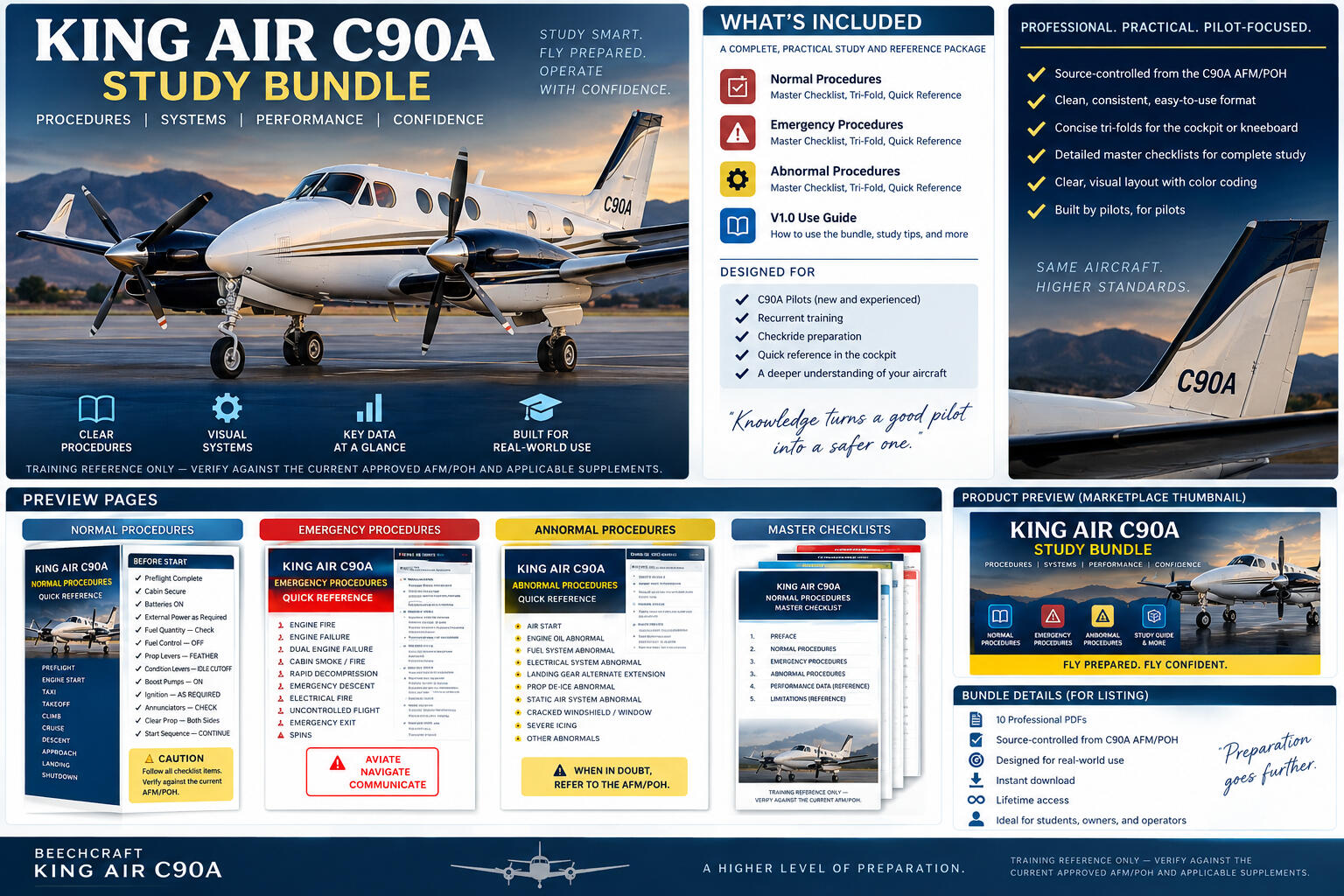
King Air training gives you a lot to absorb
Procedures, limitations, flows, memory items, abnormal situations, emergency actions, and aircraft-specific details can quickly become scattered across manuals, checklists, notes, and training materials.
The Common Bearing King Air C90A Study Bundle was built to make that material easier to organize, review, and retain.Instead of trying to make one checklist serve every purpose, the bundle uses three layers of study:Master Checklists
Detailed procedures reference for thorough study.Tri-Folds
Condensed phase-of-flight references for chair-flying and recurrent review.Quick Reference Cards
Fast-access material for repetition, recall, and focused study.
10 Files. One Consistent Study System
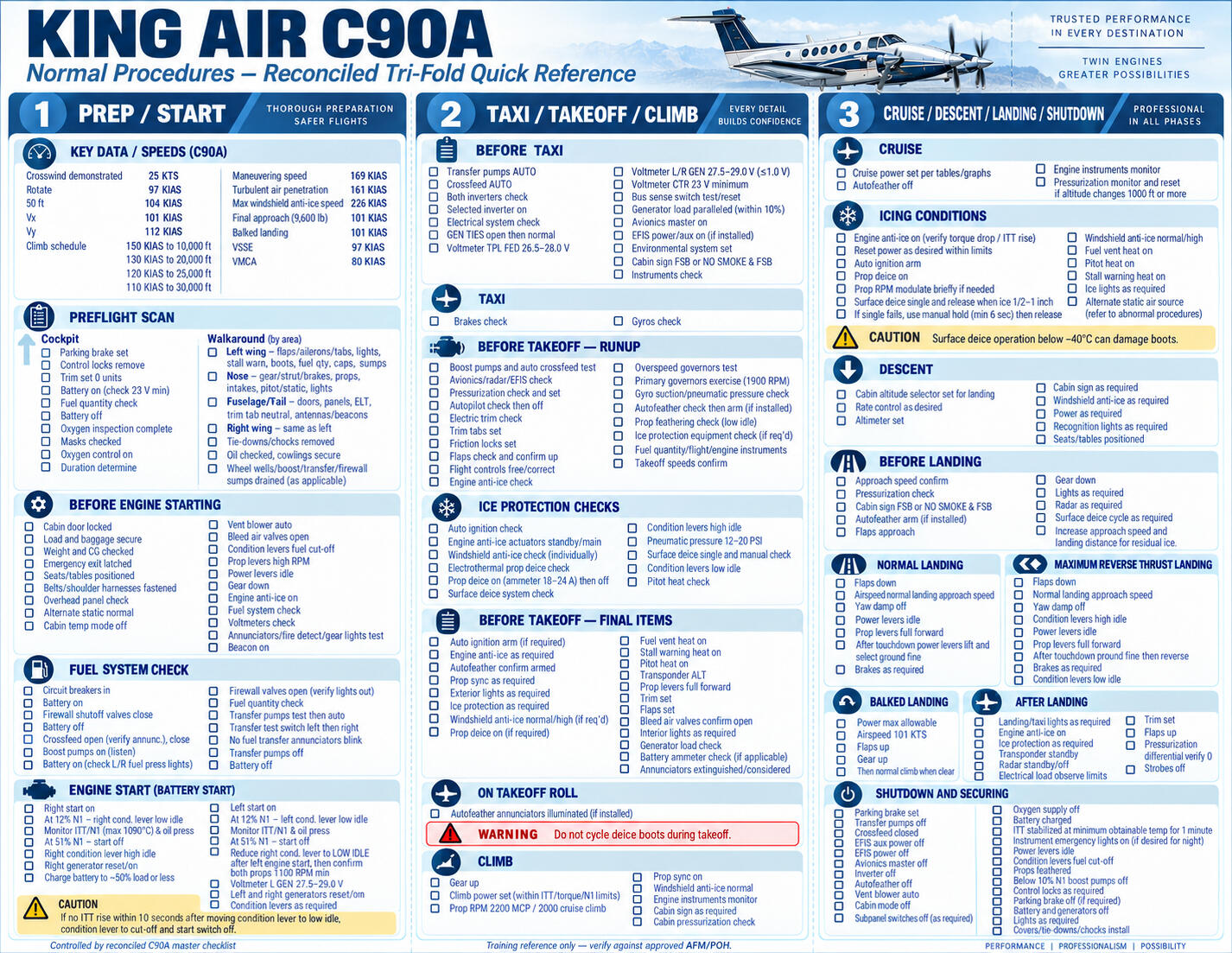
Normal Procedures
C90A Normal Procedures-Master Checklist
C90A Normal Procedures-Tri-Fold
C90A Normal Procedures-Quick Reference
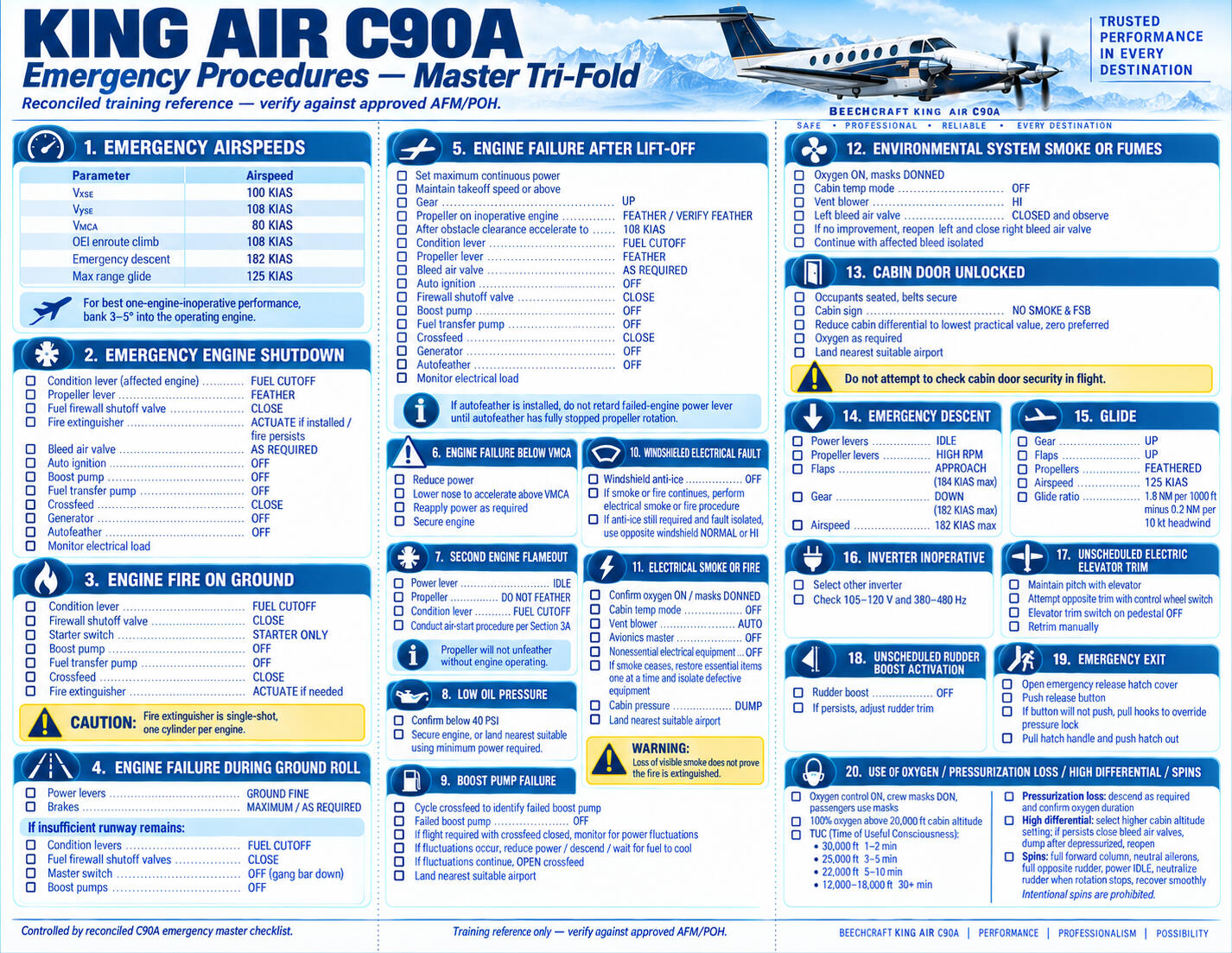
Emergency Procedures
C90A Emergency Procedures-Master Checklist
C90A Emergency Procedures-Tri-Fold
C90A Emergency Procedures-Quick Reference
Abnormal Procedures
C90A Abnormal Procedures-Master Checklist
C90A Emergency Procedures-Tri-Fold
C90A Emergency Procedures-Quick Reference
Bundle Guide
C90A Study Bundle V1.0 - Contents & Use Guide
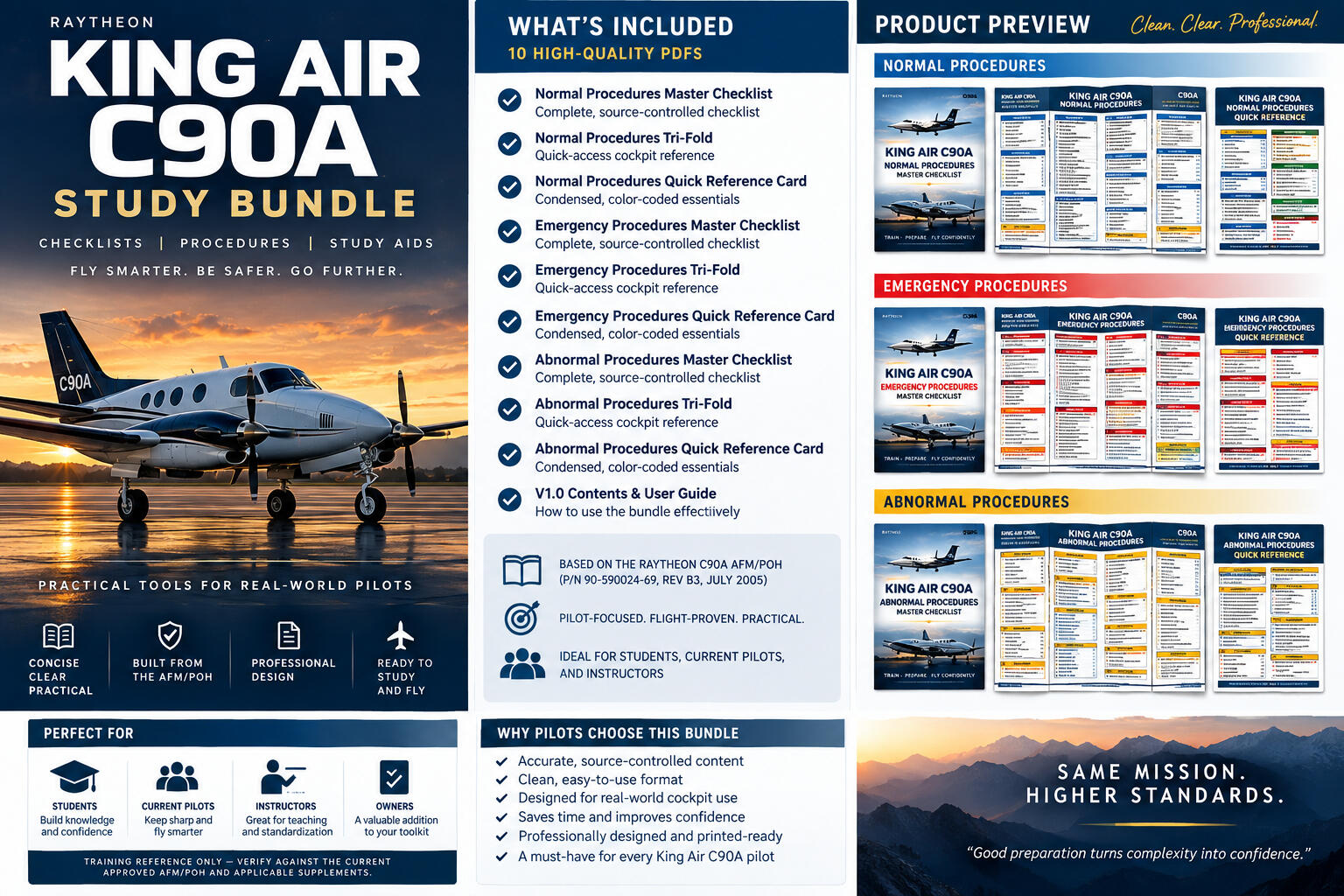
Built for Study - Not Just Storage
A stack of PDFs is not automatically a study system.This bundle was organized around how pilots actually learn and review procedures:Detailed when you need depth.
Use the master checklist when studying an entire procedure from beginning to end.Condensed when you need repetition.
Use the tri-folds for chair-flying, sequence review, and recurrent preparation.Fast when you need recall.
Use the quick-reference cards to reinforce key actions without reopening a full manual.The consistent visual structure across Normal, Emergency, and Abnormal procedures makes it easier to move from one subject to another without relearning the layout.
Built From the C90A Procedure Source Material
The V1.0 Procedure Core was developed by reconciled the procedure material used for this realease against the applicable King Air C90A AFM/POH source material.That is also why this release is specifically labeled C90A rather than loosely combining multiple King Air variants into one checklist.Aircraft serial number, installed equipment, modifications, supplements, and operator procedures can differ.The current approved AFM/POH and applicable supplements always remain the controlling authority.
Designed for pilots who want a better study workflow
This bundle may be useful for:
pilots entering King Air C90A training
pilots preparing for recurrent training
checkride or proficiency preparation
owners learning their aircraft more deeply
instructors looking for structured study material
turbin-transition pilots
pilots who prefer chair-flying and visual reference tools
See the material before you buy
Normal Procedures
Emergency Procedures
Abnormal Procedures
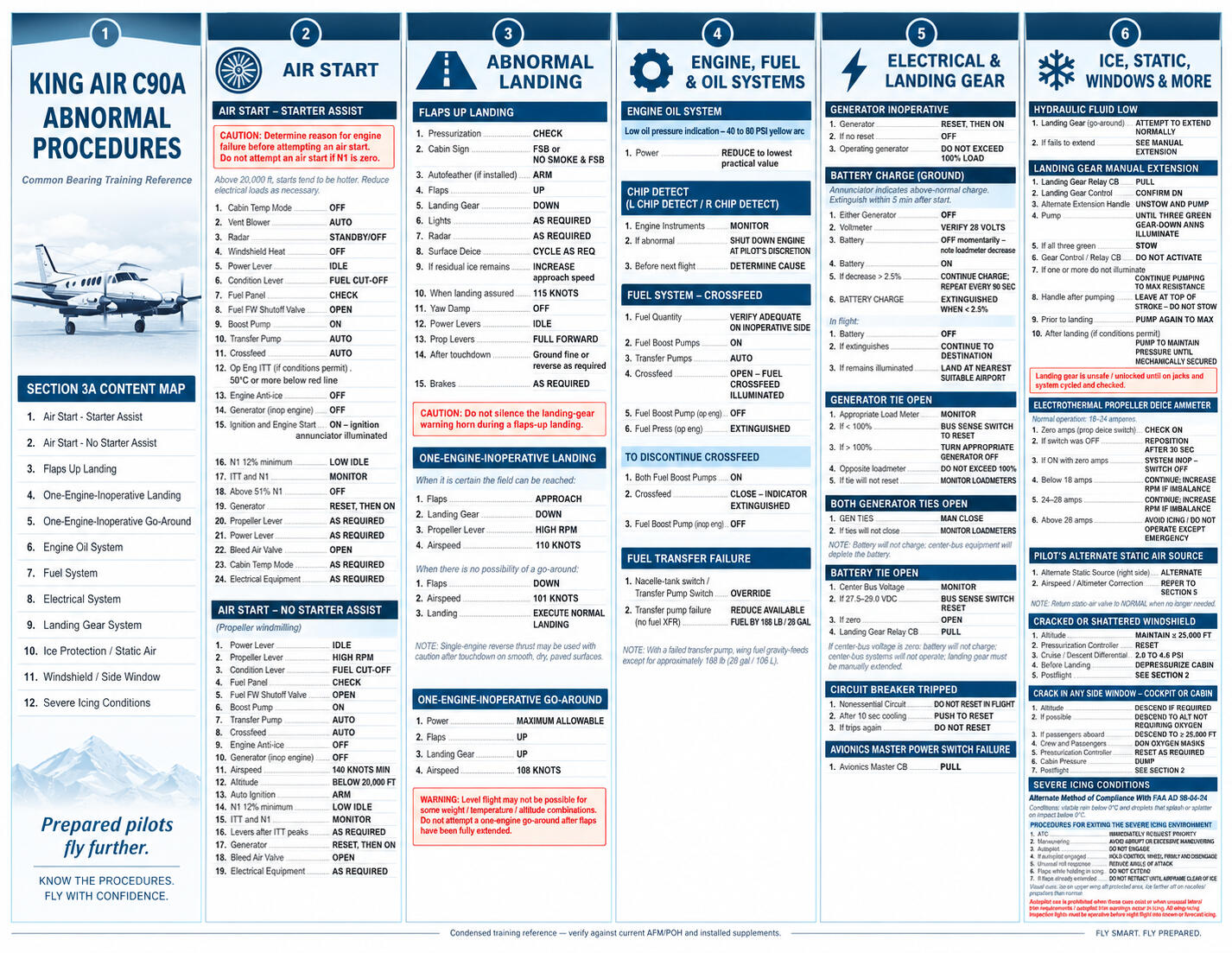
Clean. Consistent. Pilot-Focused
How to use it
A simple study workflow
1 - Learn it
Read the appropriate master checklist and understand the sequence.2 - Chair-fly it
Work through the tri-fold without rushing.3 - Recall it
Use the condensed quick-reference card to reinforce the flow.4 - Verify it
Compare your study material with the current approved aircraft documentation and your training provider or operator procedures.
King Air C90A Study Bundle V1.0
Launch Price: $24Regular Price: $29Includes:
10 digital PDF files
Normal Procedures set
Emergency Procedures set
Abnormal Procedures set
Contents & Use Guide
Instant digital delivery
Print-friendly files
Digital product • No physical item shipped
Training Reference Only
The Common Bearing King Air C90A Study Bundle is an educational and study resource. It is not an FAA-approved checklist, AFM, POH, flight manual supplement, or substitute for aircraft-specific documentation.Always verify procedures, limitations, speeds, installed equipment, and operating practices against the current approved AFM/POH, applicable supplements, operator procedures, and qualified training guidance before flight.No personalized flight instruction, consulting, or advisory service is included with this purchase.
FAQ
Is this an approved King Air checklist?No This is a training and study reference. The current approved AFM/POH and applicable supplements remain controllingIs this for the C90A or C90BV1.0 of the Procedure Core is specifically labeled C90A, because the reconciled procedure material used as the controlling basis for this release is C90A.What format are the files?PDF. They are designed to be easy to view digitally and print.Is anything shipped?No. This is a digital downloadDoes the purchase include flight instructing or consulting?No. The purchase includes the digital study materials only.Are systems diagrams included?Not in V1.0 Procedure Core. Systems and engine study materials are being treated as a separate expansion layer so they can complete their own technical QA before release.
Better preparation starts with better organization.
King Aire C90A Study Bundle V1.0 - Procedure Core
$24 Launch Price
Common Bearing
Know the procedures. Find your bearing.
Pilot Library
Practical resources for every stage of flight training
Whether you're thinking about your first lesson, working toward a certificate, building time, or learning a new aircraft, the Pilot Library helps you find the information that matters now.
Start Where You Are
Let's put something here
Zero Hours
For people figuring out how to start
How flight training works
Part 61 vs. Part 141
Choosing a flight school
Training costs and financing
How often you should fly
Your path from zero hours to Private Pilot
Student Pilot
For pilots actively working toward Private
Private Pilot ACS resources
Maneuver guides
Radio phraseology
Traffic patterns
Airspace
Weather minimums
Checkride preparation
Training planners and study tools
Instrument Pilot
For pilots learning to operate in the IFR system
IFR procedures
Approaches
Holds
Clearances
Radio Work
Instrument Scan
Weather and decision-making
Aircraft-specific IFR rescources
Commercial Pilot
Let's put something here
Time-building strategy
Multi-engine training
CFI pathway
Career planning
Airline preparation
Aircraft study materials
Advanced training resources
Time Building & Career
For pilots moving beyond the certificates
Time-building strategy
Multi-engine training
CFI pathway
Career planning
Airline preparation
Aircraft study materials
Advanced training resources
Featured Resources
Let's put something here
Zero-to-PPL Roadmap
A practical overview of what happens from your first lesson through your Private Pilot checkride.
Radio Phraseology Starter Card
A quick-reference guide for the radio calls student pilots use most often.
Traffic Pattern Quick Reference
Pattern entries, positions, calls, and common mistakes in one place.
Cessna 172 G1000 Study Pack
Aircraft-specific systems, procedures, avionics, and practical training references.
Coming Soon
King Air C90 Quick Reference Pack
PT6 power management, V-speeds, and phase-of-flight configuration guidance
Browse by Topic
Flight Training
Private Pilot
Instrument
Aircraft Systems
Avionics
Radio Communications
Weather
Airspace
Checkride Prep
Time Building
Career Development
Safety & Decision Making
Free First
Start with the free resources
You shouldn't need to buy a study package just to understand how flight training works.Common Bearing publishes practical guides, checklists, explanations, and planning tools designed to help you understand what matters before you spend money.When you need something more specialized - aircraft-specific training material, advanced study tools, or personal guidance - it's available too.
Need Help Applying It?
Still not sure what applies to your situation?
The roadmap can tell you how flight training generally works.
Sometimes the harder question is:
Which school should I choose?
How often should I fly?
Should I train Part 61 or 141?
Is this aircraft a good fit?
How should I structure my training?
What should I do next?
If the library still doesn't answer your question, you can book time with a CFI and get help applying the information to your own goals, schedule, and budget.
Aircraft Library
Study by Aircraft
Cessna 172
G1000 study resources, systems, procedures, flows, and checklists
Piper Seminole
Multi-engine systems and training resources
King Air C90
PT6 systems, power management, limitations, and configuration guides.
Pipistrel Alpha Trainer
Aircraft-specific familiarization and operating resources
Beechcraft Baron B58
Coming later.
Beechcraft Bonanza
Coming later.
Build Your Own Pilot Library
New resources are added as the library grows
Use the Pilot Library as a reference throughout your training. Bookmark what you need now and come back as you move into the next stage.
Get new resources by email
You don't need more information. You need the right information at the right time.